

Introduction to Defense in Depth: A Layered Approach to Cybersecurity
Why a Single Security Measure Isn’t Enough—How Layered Defenses Protect Against Modern Cyber Threats.

Intended Audience: Beginner cybersecurity professionals, business leaders, and anyone interested in strengthening their organization's security posture.
In cybersecurity, no single security measure is foolproof. Attackers are constantly evolving their tactics, and relying on just one line of defense such as a firewall or antivirus software, can leave critical gaps. That’s where Defense in Depth comes in.
Defense in Depth is a layered security strategy designed to create multiple barriers against cyber threats, ensuring that if one control fails, others remain in place to protect critical systems and data. This approach has been widely adopted by governments, businesses, and security-conscious organizations to mitigate risk and improve resilience.
What is Defense in Depth?
Defense-in-Depth is a layered security strategy designed to protect mission-critical systems and data by implementing multiple levels of security controls. Instead of relying on a single line of defense, organizations apply overlapping security measures across different areas such as perimeter, network, endpoint, application, and data security to slow attackers, detect threats early, and reduce the risk of a complete system compromise.
This approach follows the fundamental security principle of redundancy: if one control fails, others remain in place to stop or mitigate an attack. Think of it like a medieval castle, an attacker must breach the outer walls, cross the moat, get past armed guards, and navigate inner defenses before reaching the heart of the castle. The more layers in place, the harder it is for an adversary to succeed.
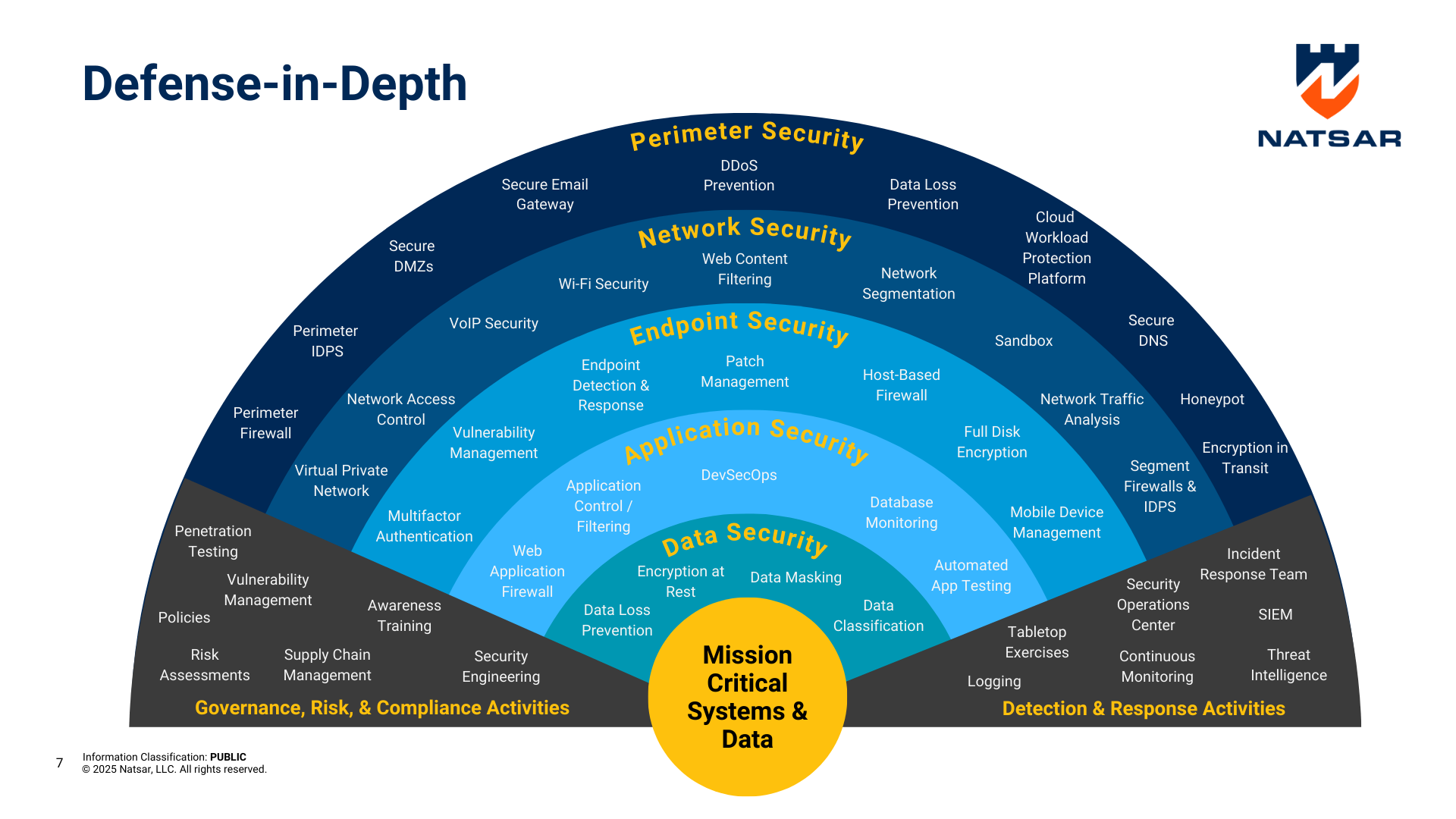
The Defense-in-Depth Fan Chart above illustrates how security measures span across multiple layers:
Perimeter Security: The first line of defense, including firewalls, secure email gateways, DDoS prevention, and data loss prevention to block external threats.
Network Security: Measures like network segmentation, web content filtering, and secure DNS prevent unauthorized access and contain threats before they reach critical systems.
Endpoint Security: Protects individual devices through patch management, endpoint detection and response (EDR), and host-based firewalls to defend against malware and exploits.
Application Security: Focuses on securing software and services using DevSecOps, web application firewalls (WAFs), and automated security testing.
Data Security: The last line of defense, ensuring encryption, data masking, and classification protect sensitive information from unauthorized access or loss.
GRC & Detection & Response: The Cross-Cutting Layers of Security
While each security layer serves a unique function, Governance, Risk & Compliance (GRC) and Detection & Response Activities cut across all of them, ensuring security is proactively managed, continuously monitored, and strategically aligned with business objectives:
Governance, Risk & Compliance (GRC): Includes risk assessments, policy development, security awareness training, vulnerability management, and supply chain security to establish a strong foundation for security programs.
Detection & Response Activities: Covers incident response teams, continuous monitoring, security information and event management (SIEM) solutions, security operations centers (SOCs), and threat intelligence, helping organizations quickly detect and mitigate active threats.
By integrating these layers with a mature GRC strategy and continuous detection and response capabilities, organizations create a security posture that not only prevents breaches but also provides resilience when one layer is compromised. Whether defending against cybercriminals, nation-state actors, or insider threats, Defense-in-Depth ensures that no single point of failure results in a catastrophic security breach.
Challenges of Implementing Defense in Depth
While Defense in Depth is highly effective, it does come with challenges:
Complexity: More layers mean more security tools to manage and configure properly.
Cost: Implementing multiple security measures requires investment in technology and personnel.
Balancing Security and Usability: Overly strict security measures can frustrate users and impact productivity.
Organizations must strike a balance between effective security and operational efficiency, ensuring that protections don’t disrupt business processes while still mitigating risk.
Bottom Line
Defense in Depth is a proven cybersecurity strategy that enhances resilience by layering security controls at multiple levels. Instead of relying on a single solution, organizations implement redundant, overlapping security measures to prevent, detect, and mitigate cyber threats. While implementation requires careful planning and resource allocation, the benefits of reduced risk, improved detection, and enhanced compliance far outweigh the challenges.
Learn More About Defense in Depth and Earn a Continuing Education Certificate
For a deeper dive into implementing Defense in Depth strategies, watch our no-cost training video, Introduction to Defense in Depth, available on YouTube or through Natsar’s website. Completing the training on Natsar’s website allows you to earn a certification for Continuing Professional Education (CPE) credits—ideal for cybersecurity professionals looking to enhance their expertise.
How Natsar Can Help
Natsar provides expert-led training and consulting services to help organizations implement Defense in Depth strategies effectively. Whether you need assistance with network security, zero trust, endpoint protection, or compliance, we offer customized solutions to strengthen your security posture.
Visit Natsar’s website to explore our training, cybersecurity assessments, and risk management solutions.
The Defense in Depth chart is very helpful and informative. Thank for the article!